



 Home
HomeLoad Bearing Performance Report: MDF vs Particle Board Strength Analysis
 26 May,2026
Why Shelves Sag: The Real Problem Behind Furniture Failure
Walk into any office space or residential library that is more than a few years old, and you will likely spot it: bowing bookshelves, misaligned wardrobe doors, and cabinet floors that have begun to warp under the weight of their contents. These are textbook examples of structural failure in casegood furniture.
While consumers often blame the visual exterior, most furniture failures are not caused by the decorative surfaces. They originate deep within the substrate due to insufficient load-bearing performance of the core board. When assessing furniture board strength, manufacturers must look beyond surface aesthetics and evaluate how the core material handles sustained mechanical stress.
The industry constantly debates MDF vs particle board strength. Both are ubiquitous in furniture manufacturing, but their distinct internal structures dictate entirely different load-bearing behaviors. Understanding this engineered wood strength comparison is critical for preventing long-span bending, screw loosening, and catastrophic cabinet panel collapse under load.
Test Setup: Evaluating Modulus and Static Load
To objectively determine the weight capacity of MDF vs particle board, our evaluation bypasses theoretical marketing claims and focuses on standardized physical testing. The goal of any rigorous board load testing is to isolate variables.
For this structural comparison, we established the following baseline parameters:
- Specimens: 18mm standard density MDF (720 kg/m³) vs. 18mm standard Particle Board/Chipboard (650 kg/m³).
- Dimensions: 800mm unsupported span length, typical for standard cabinetry.
- Environment: Climate-controlled at 20°C and 65% relative humidity.
In wood engineering, two metrics govern a board's capability:
- MDF modulus of rupture (MOR): The ultimate breaking strength. This tells us the maximum load the board can take before snapping.
- Modulus of elasticity wood boards (MOE): The stiffness of the board. This predicts how much the material will flex or bow before breaking.
During the particle board bending strength test and the static load test for MDF, uniform weights were applied progressively to the center of the span. We recorded immediate deflection, elasticity, and the exact threshold of structural failure.
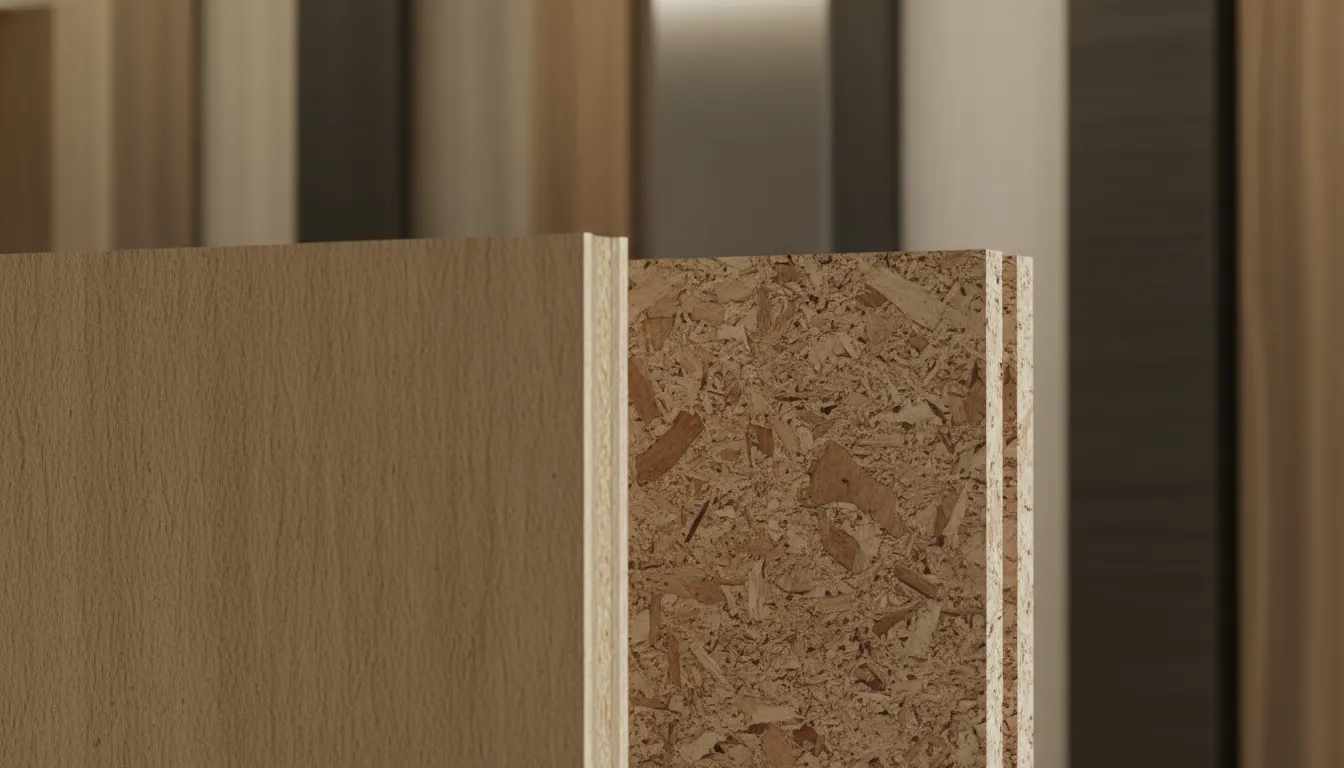
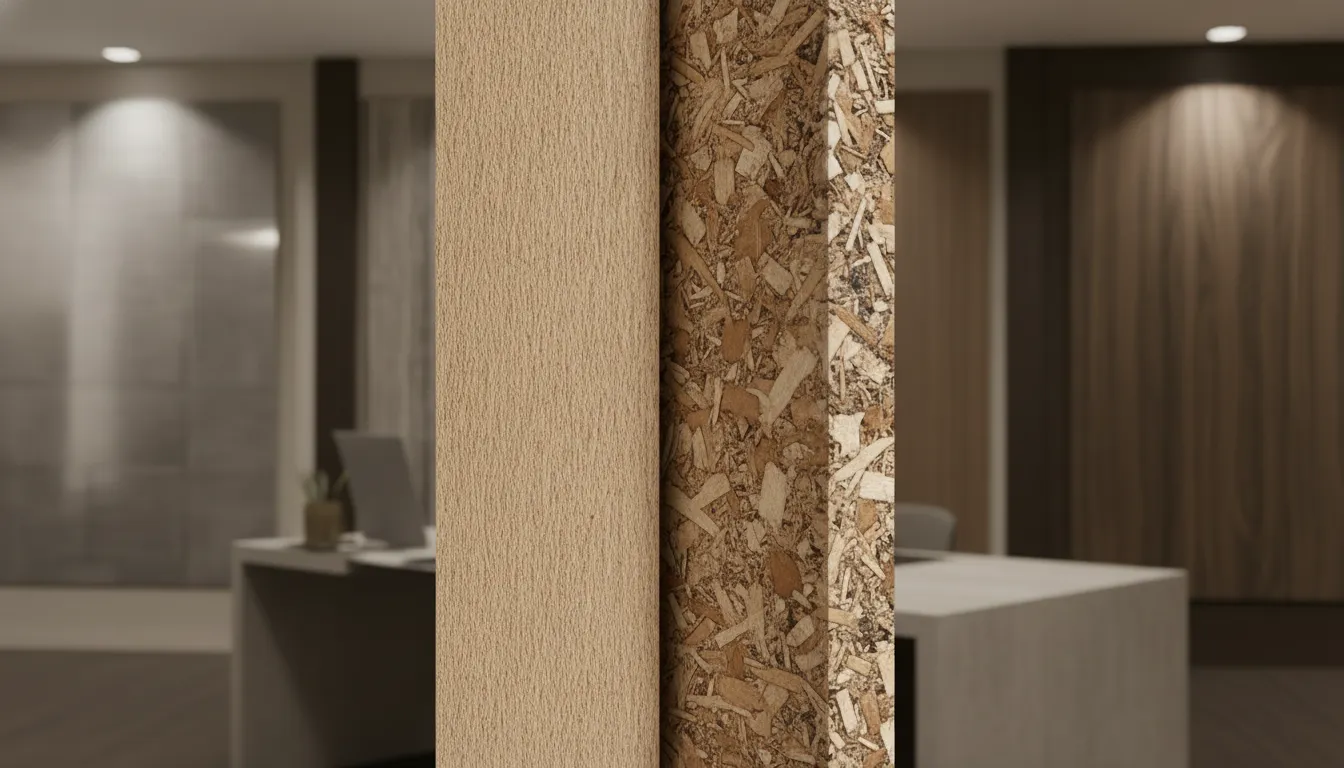
24-Hour Load Test Results: Initial Deflection Behavior
The first phase of the evaluation involves a 24-hour shelf deflection test using a concentrated 50kg center load. This mimics the strain of heavy textbooks or a stack of ceramic plates.
When asking how much weight can MDF hold, the 24-hour mark provides insight into its density stability. Because Medium Density Fiberboard is created from fine wood fibers pressed uniformly, it reacts to stress homogeneously. Under the 50kg load, the MDF specimen exhibited a smooth, predictable flex. The board sagging resistance is moderate; the panel bows, but the internal fibers distribute the tension evenly across the span, preventing edge cracking.
Conversely, evaluating chipboard vs MDF load capacity reveals particle board’s distinct three-layer structure. Modern particle board features dense outer layers of fine particles and a looser core of larger chips. During the initial 24 hours, the dense outer faces of the particle board provided excellent rigidity, actually showing slightly less initial deflection than the MDF.
However, this rigidity has a sharp limit. Once the tension on the bottom face of the particle board exceeds its tensile strength, the looser core cannot distribute the load effectively, leading to rapid, localized failure rather than the gradual bowing seen in MDF shelf sagging.
Long-Term Deformation: Structural Fatigue After 30 Days
Furniture does not exist in a 24-hour vacuum. The true test of a substrate is how it handles continuous, unrelenting pressure. All engineered woods are susceptible to creep—a phenomenon where material slowly and permanently deforms under a constant load over time.
Does particle board sag over time? Absolutely. After 30 days of continuous loading, both panels exhibited long-term load deformation. However, the nature of the fatigue differed significantly. The particle board began to experience internal microscopic shear failures. The adhesive bonds holding the larger core chips together began to stretch and micro-fracture, causing the board to lose its elastic memory. If the load is removed after 30 days, a particle board shelf will retain a permanent, visible bow.
Warped MDF shelves also occur, but due to its high uniform density, the structural stability of MDF panels allows for a more predictable creep curve. It will sag, but it is less prone to sudden core shear failure. For long spans without center supports, neither standard material is immune to cabinet panel bending, which is why engineering the furniture’s geometry (like adding backer-board structural bracing or heavy edge-banding) is just as critical as the board selection itself.
Screw Holding Capacity: The Hidden Structural Factor
When discussing the best engineered wood for load bearing furniture, raw panel deflection is only half the equation. A shelf might hold the weight, but if the shelf pins rip out of the cabinet wall, the system fails.
Screw holding capacity particle board is heavily dependent on the density of the board's core. Because particle board has a porous center, standard wood screws can struggle to find purchase. If over-torqued, the chips simply strip out. To maximize grip in particle board, manufacturers must use specialized coarse-thread confirmat screws designed to bite into the larger wood flakes.
What board material holds screws better? For face-screwing (screwing directly into the flat surface), MDF provides superior, highly consistent grip due to its dense, void-free fiber composition. However, MDF has a distinct weakness: edge splitting. Driving a screw into the thin edge of an MDF panel without pre-drilling will almost certainly split the board, acting like a wedge driven into layers of paper.
When evaluating MDF vs particle board for shelving weight, designers must account for how the load transfers to the fasteners. Particle board often provides better shear resistance for dowels and shelf pins, provided the board quality is high and the pins rest firmly against the high-density surface layers.
Moisture & Humidity Impact on Load Bearing Performance
Mechanical stress is drastically amplified by environmental moisture. The humidity impact on furniture boards cannot be overstated. As engineered wood absorbs ambient moisture, the internal adhesive bonds degrade, and the wood fibers expand.
Particle board swelling issues are a primary cause of structural failure in kitchens and bathrooms. When moisture penetrates the unsealed edges of standard particle board, the compressed chips expand rapidly, permanently destroying the panel's internal integrity and reducing its load capacity to near zero.
By comparison, standard MDF also absorbs moisture and swells, though generally at a slower, more uniform rate than the erratic expansion of chipboard. For demanding environments, engineers pivot to moisture resistant MDF (MR MDF) or high-grade moisture-resistant particle board (often dyed green). These boards utilize specialized melamine urea-formaldehyde (MUF) resins that prevent the panel from losing its MOR and MOE when subjected to high humidity, ensuring long-term engineered board durability.
Application Analysis: Selecting the Right Substrate
Which is stronger MDF or particle board? The answer depends entirely on the directional force and the specific furniture application.
- Kitchen Cabinet Board Materials: High-quality particle board (18mm+) remains the industry standard for cabinet carcasses. It offers excellent dimensional stability, sufficient rigidity for vertical loads, and lighter weight.
- Best Board Material for Heavy Shelves: For long bookshelves spanning over 800mm, neither standard MDF nor standard particle board is ideal without reinforcement. Plywood or blockboard reigns supreme here. If engineered wood must be used, 25mm thick particle board or structurally reinforced MDF is required to combat creep.
- Commercial Furniture Board Materials: Desktops and commercial tables often utilize MDF cores because MDF allows for smooth, machined edge profiles and provides a perfectly flat substrate for pressing high-pressure laminates (HPL).
- Heavy-Duty Shelving Boards: In garage or industrial settings, specialized high-density particle boards are preferred over MDF because they offer better resistance to sudden impact loads and are less prone to edge-crushing under heavy metal hardware.
Industry Insight: Why Cheap Furniture Fails Faster
Procurement professionals often wonder why two visually identical cabinets perform so differently. The secret lies in the manufacturing tolerances of the substrate.
To compete on price, low-cost factories frequently reduce the density of their boards. Dropping a particle board from 680 kg/m³ to 600 kg/m³ saves significant raw material costs, but it exponentially destroys the board's MOE and screw holding capacity. Furthermore, cheaper boards utilize lower ratios of synthetic resin binders and shorter pressing cycles.
This results in a board with a "spongy" core. The moment a heavy load is applied, the weak internal bonds shear. The shelf doesn't just bend; the internal structure collapses. Structural failure in B2B casegoods is rarely an accident of design; it is usually a direct mathematical result of aggressive substrate cost-cutting.
Surface Protection and Core Integrity
Ultimately, the mechanical strength of any engineered panel relies on its protection from external elements. A high-density core will only maintain its load-bearing properties if it is shielded from humidity, UV degradation, and surface abrasion.
This is where the relationship between the structural board and the decorative surface becomes vital. As a supplier of premium decorative films and surface materials, WellP understands that lamination is not merely an aesthetic choice—it is a structural necessity. High-quality PET, PP, and PVC films, when applied with precise pressure and superior adhesives, create a protective envelope around the substrate.
By sealing out moisture and resisting surface impacts, advanced decorative surfaces ensure that the MDF or particle board beneath retains its modulus of elasticity and dimensional stability for years, allowing furniture manufacturers to deliver casegoods that look exceptional and perform flawlessly under pressure.
 The Architecture of Silence: Coordinating Hidden Handle Systems with Premium Surface Finishes