



 Home
HomeThe Physics of Touch: Engineering Nano Anti-Fingerprint Technology for Modern Decorative Surfaces
 18 May,2026
The Physics of Touch: Engineering Nano Anti-Fingerprint Technology for Modern Decorative Surfaces
The transition toward minimalist interior architecture over the past decade has fundamentally altered the demands placed on furniture materials. As designers increasingly specify ultra-matte, dark-toned, and handle-less cabinetry, a new functional challenge has emerged: the human touch. Why do fingerprints appear so dramatically on certain premium matte cabinet doors, while they almost disappear on others?
The answer is not a matter of simply keeping surfaces clean. Fingerprints are a complex surface energy engineering problem. The rise of handle-less design means that fingerprint resistant kitchen cabinets and fingerprint free furniture surfaces are no longer luxury upgrades; they are structural necessities. As the market demands a soft touch anti-fingerprint surface that feels as warm as natural materials but performs like an industrial polymer, the decorative surface industry has had to look to nanoscale engineering to solve microscopic problems.
Fingerprints Are Actually an Optical Problem
To engineer a solution, we must first understand the physics of the defect. A fingerprint is essentially a transfer of human sebum (a complex mixture of lipids, squalene, and dead skin cells) and ambient moisture onto a substrate. However, the reason we see this residue on an ultra-matte surface is purely optical.
Standard matte surfaces achieve their low-gloss appearance through micro-surface topology. The surface is intentionally engineered with microscopic peaks and valleys. When light hits this textured surface, it scatters in multiple directions—a phenomenon known as diffuse reflection. This scattering creates the characteristic non-reflective, optical matte effect that designers prize.
When a finger touches this surface, the sebum transfers into the microscopic valleys of the texture. The oil essentially "fills in" the micro-topology, creating a localized, smooth micro-oil film. Because the refractive index of sebum (roughly 1.4 to 1.5) is different from the surrounding air and similar to the polymer substrate, it alters how light behaves at that specific spot. The diffuse reflection is locally disrupted and replaced by specular (directional) reflection.
The human eye perceives this sudden shift in optical contrast as a dark, glossy smudge against the flat matte background. Therefore, preventing fingerprints is not about stopping the physical transfer of oil; it is about preventing the oil from wetting the surface and disrupting the microscopic light-scattering structures.
The Mechanisms of Nano Anti-Fingerprint Technology
Addressing this optical disruption requires sophisticated surface chemistry. Nano anti-fingerprint technology operates by manipulating the molecular interactions between the substrate and the contaminant.
The foundational principle here is surface energy reduction. A surface with high energy will aggressively pull liquids into its microscopic pores, causing them to spread flat (wetting). To combat this, engineers apply an oleophobic coating (oil-repelling), typically utilizing advanced fluoropolymer or specialized silicone-based nano-resins.
When an Anti-fingerprint coating is applied, it lowers the surface energy of the decorative film drastically. This is quantified by measuring the contact angle—the angle at which a liquid droplet meets a solid surface. A standard polymer might exhibit an oil contact angle of 20 to 40 degrees, allowing oils to spread easily. An advanced AFP coating elevates this contact angle to 70 degrees or higher for oils, and over 110 degrees for water (hydrophobicity).
Because of this low surface adhesion, the sebum from a fingerprint cannot easily spread into the micro-valleys of the substrate. Instead, the microscopic droplets remain suspended on the peaks of the nano-texture. Because the oil does not form a continuous film, the diffuse reflection remains largely uninterrupted, rendering the fingerprint optically invisible to the naked eye. This is the true mechanism behind a highly effective smudge-proof nano coating.
Why Matte & Soft-Touch PET Surfaces Need Advanced AFP Coatings
Historically, high-gloss surfaces have been the most notorious fingerprint magnets in the furniture industry. On a perfectly smooth, high-gloss finish, even the slightest transfer of sebum creates thin-film interference, disrupting the mirror-like specular reflection and creating highly visible smudges.
However, the engineering challenge compounds significantly when dealing with modern ultra-matte and soft-touch polymers like PET. While glossy surfaces show smudges due to flat surface interruption, matte surfaces suffer from a fundamentally different optical failure: texture flooding.
Standard matte surfaces achieve their low-gloss appearance through microscopic peaks and valleys that scatter light. When sebum transfers onto an untreated matte surface, the oil physically floods these micro-valleys. This liquid visually "smooths out" the topography, causing that specific spot to suddenly reflect light directionally (glossy) instead of diffusely (matte). The resulting high-contrast shiny spot against a dark matte background is not only visually jarring but also notoriously difficult to clean because the oil becomes mechanically trapped within the texture.
Therefore, creating a true matte anti-fingerprint PET requires a delicate balance of tactile surface engineering and optical performance. Engineering an anti-fingerprint decorative film that maintains a velvet-like soft touch requires highly precise nano-scale coating distribution.
If the oleophobic coating is too thick, it fills the valleys and destroys the matte effect. Advanced fingerprint resistant laminate systems achieve this balance through techniques like excimer laser curing. This process polymerizes the surface in an oxygen-free chamber, creating a microscopic, densely cross-linked folded topography. The advanced AFP chemistry must perfectly conform to this intricate structure at the nanometer level. By doing so, it creates a low-surface-energy barrier across the extreme peaks, forcing the oil droplets to remain suspended rather than flooding the valleys, thus preserving both the optical matte effect and the tactile softness.
The Hidden Challenge: Durability of Nano Coatings
A significant vulnerability in the modern surface materials supply chain is the proliferation of low-cost, chemically grafted anti-fingerprint treatments. Many manufacturers apply a superficial spray-on surfactant that performs beautifully in a showroom but degrades rapidly in a real-world environment.
The true metric of a high-performance smudge-proof cabinet doors is long-term surface contamination resistance and coating durability. Nano-coatings are subject to continuous tribological stress—friction from cleaning cloths, abrasion from hands, and chemical attacks from household degreasers.
When inferior coatings fail, they do not fail uniformly. The oleophobic properties wear off in high-touch zones (like the edges of handle-less doors), leading to permanent, un-cleanable glossy patches. To prevent this, advanced R&D focuses on incorporating the nano-particles directly into the cross-linked polymer matrix of the topcoat, rather than just floating them on the surface. By utilizing electron-beam (E-beam) or advanced UV-curing technologies, the anti-smudge properties become structurally integral to the PET film itself, providing extreme abrasion resistance and ensuring the material withstands thousands of wipe cycles without losing its low-surface-energy characteristics.
Real Furniture Applications Driving AFP Demand
The commercial realities of the furniture industry are pulling these advanced materials out of the laboratory and into high-volume production. The strongest demand vector is the kitchen sector, where fingerprint resistant kitchen cabinets have shifted from a premium differentiator to a baseline expectation.
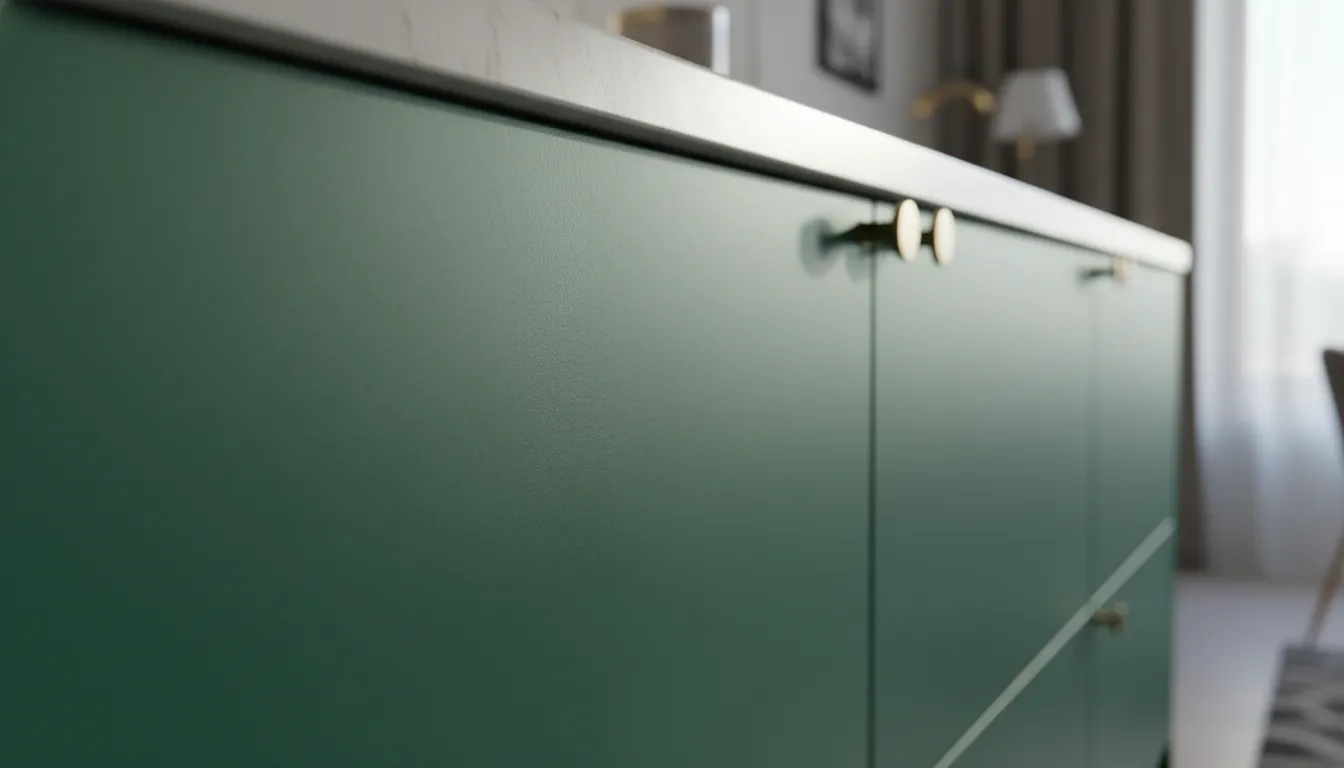
The widespread adoption of midnight blues, charcoal grays, and deep forest greens in modern kitchen design has amplified this need. Dark pigments absorb more light, making any specular reflection (like an oil smudge) appear significantly brighter and more disruptive to the eye. Consequently, specifying the best anti-smudge coating for kitchen cabinets is critical for architects and brands working with dark palettes.
Beyond residential kitchens, commercial interiors are adopting these materials rapidly. Hospitality environments, modern office wardrobing, and architectural wall panelling require materials that maintain a pristine aesthetic with minimal maintenance staff intervention.

Future Direction: Smart Functional Decorative Surfaces
As surface engineering matures, the decorative panel industry is moving beyond passive coatings toward active, smart functional surfaces. The next generation of PET films will not only resist oils but actively manage their environment.
We are already seeing the integration of self-healing polymers into ultra-matte surfaces, where micro-scratches—which can disrupt both the optical matte effect and the oleophobic layer—can be repaired through the application of thermal energy. Furthermore, the convergence of anti-bacterial nano-surfaces with anti-fingerprint technology is creating a new category of intelligent surface materials. By embedding silver or zinc nanoparticles into the same cross-linked matrix that houses the oleophobic fluoropolymers, engineers are developing materials that stay visually clean while actively neutralizing surface pathogens.
Engineering the Next Generation of Surfaces
The demand for flawless, tactile, and resilient furniture surfaces is driving rapid innovation in polymer science. Supplying the modern panel and furniture industry requires more than just extruding plastic; it requires a deep understanding of optical physics, surface energy, and advanced coating methodologies.
As a manufacturer focused entirely on the progression of decorative surfaces, WellP is continuously advancing the engineering behind anti-fingerprint PET film and engineered board solutions. By prioritizing highly durable, cross-linked nano-coating systems, WellP ensures that the visual integrity and tactile luxury of ultra-matte surfaces endure the rigors of real-world manufacturing and daily human interaction.
Technical FAQ
Q: How does anti-fingerprint coating work at the chemical level?
A: Anti-fingerprint coatings utilize specialized chemical compounds, often fluoropolymers, to significantly lower the surface energy of the substrate. This creates an oleophobic (oil-repelling) state. When sebum from a fingerprint touches the surface, the high contact angle prevents the oil from wetting and spreading into the microscopic texture of the matte surface, thereby preventing the localized optical shift that makes a fingerprint visible.
Q: What are the specific benefits of anti-fingerprint PET film for furniture manufacturing?
A: Beyond the obvious aesthetic advantage, AFP PET film reduces the defect rate during furniture assembly and transit, as workers' handling does not leave permanent marks. Additionally, the highly cross-linked topcoats required for true AFP performance inherently provide superior scratch resistance and chemical resistance compared to standard PVC or melamine foils, increasing the lifespan of the finished cabinetry.
Q: Anti-fingerprint vs standard matte film: What is the structural difference?
A: A standard matte film achieves its low gloss solely through mechanical or chemical texturing, but its surface energy remains high, meaning it readily absorbs and displays oils. A true anti-fingerprint matte film features a dual-layer engineering approach: a meticulously controlled micro-topology for light diffusion, overlaid or integrated with a low-surface-energy nano-coating that actively repels liquid contaminants from settling into that topology.
 The Fingertip Economy: How Tactile Design and Textured Panels Are Driving Furniture Sales