



 Home
HomePET Film for Kitchen Cabinets: Technical Considerations for Panel Manufacturers
 10 Mar,2026
For kitchen cabinet manufacturers, interior panel producers, and MDF board factories, selecting the right decorative surface material goes far beyond aesthetics. The kitchen environment presents one of the most demanding interior applications for any material, subjecting surfaces to rapid temperature fluctuations, high humidity, chemical exposure, and daily mechanical abrasion.
As a high-performance decorative film for cabinet panels, Polyethylene Terephthalate (PET) has become a primary choice for modern panel lamination. However, successfully integrating PET film for kitchen cabinets into a mass-production line requires a deep understanding of its technical properties, substrate interactions, and precise lamination parameters. This guide explores the critical engineering and production considerations required to manufacture premium PET-faced panels.
Performance Requirements for Kitchen Cabinet Surfaces
Before detailing specific material properties, production managers must understand the environmental stressors kitchen cabinets face to establish accurate quality control baselines.
- Heat Resistance: Cabinets adjacent to ovens, cooktops, and dishwashers experience localized, radiant heat up to 70°C–85°C. The surface film must not exhibit dimensional shrinkage, edge creep, or delamination under sustained thermal loads.
- Moisture and Steam Resistance: Boiling kettles and dishwashers release focused steam. A high-quality cabinet surface lamination film must act as an impermeable barrier, and its adhesive bond must not degrade in high humidity.
- Chemical Resistance: Daily exposure to cooking oils, acidic food spills (citrus, vinegar), and aggressive alkaline cleaning agents requires a non-porous surface that resists molecular staining and chemical crazing.
- Scratch and Impact Resistance: Cabinet doors face constant tactile engagement. The film must possess a surface hardness capable of withstanding fingernail gouges, abrasive cleaning pads, and impacts from kitchen utensils.
Key Technical Properties of PET Film
Evaluating PET cabinet film requires analyzing specific physical and chemical data points provided by material distributors.
Thickness Ranges
Determining the best PET film thickness for kitchen cabinets depends entirely on the substrate quality and the intended lamination process.
- 0.15mm – 0.25mm: Generally considered too thin for premium kitchen cabinets, as it fails to mask substrate imperfections (telegraphing).
- 0.30mm – 0.50mm: The industry standard for flat lamination on MDF. It provides a robust barrier and excellent dimensional stability while remaining cost-effective.
- 0.60mm – 0.80mm: Used for ultra-premium, high-gloss applications. Thicker films provide a glass-like optical depth and completely bridge minor substrate variances.
Surface Hardness and Scratch Resistance
Standard PET films inherently possess higher scratch resistance than standard PVC, but premium iterations undergo additional UV hard-coating. Engineers should look for a pencil hardness rating of 2H to 3H (ASTM D3363) for flat surfaces to ensure long-term durability against micro-scratching.
Heat Stability and Shrinkage
PET is a thermoplastic. During the lamination process—especially if subjected to high-temperature pressing—internal tensions can release, causing shrinkage. High-quality PET films for cabinet production must specify a thermal shrinkage rate of less than 0.5% in both the machine direction (MD) and transverse direction (TD) when exposed to 80°C for 24 hours.
Anti-Fingerprint (AFP) Technologies
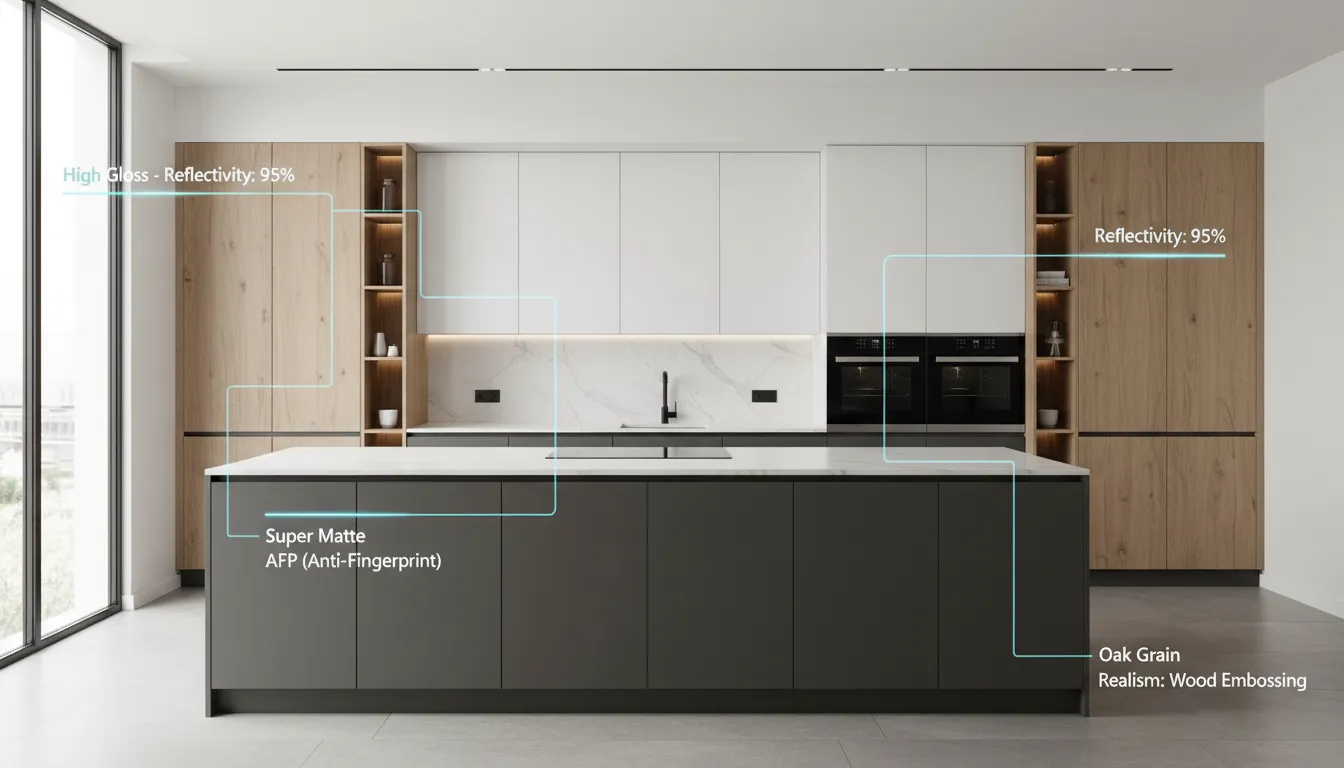
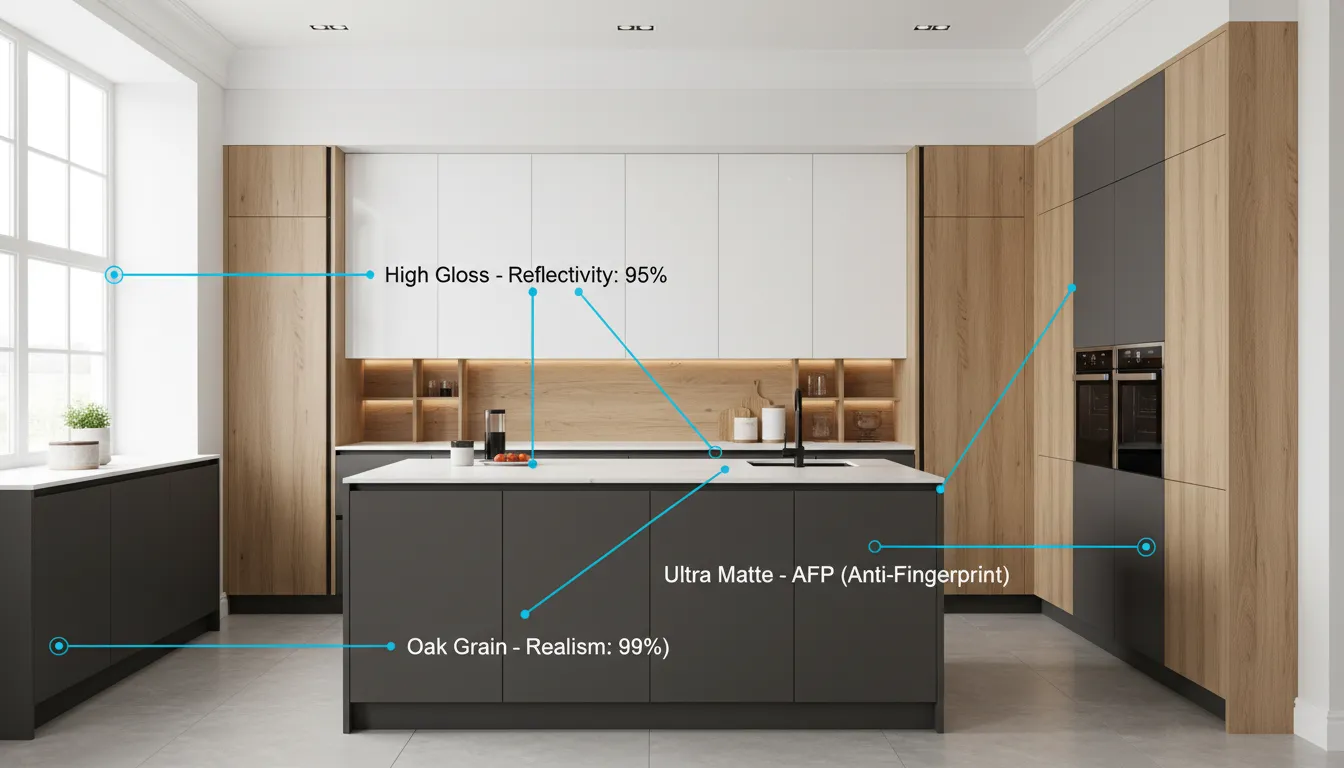
For Ultra Matte surfaces, advanced PET films utilize excimer UV curing technology. This process occurs in an oxygen-free chamber, micro-folding the top clear coat at a nanometer level. This lowers the gloss level to below 5 GU (Gloss Units) and dramatically decreases surface tension, creating a highly effective anti-fingerprint and soft-touch finish.
Surface Finish Options for Cabinet Applications
The chemical inertness of PET allows for several distinct finish profiles, each with unique manufacturing considerations.
High Gloss PET
Demands an absolute dust-free lamination environment. Even micro-particles under a high-gloss film will result in visible optical distortions. High gloss PET typically requires an application of a protective masking tape with a tightly controlled peel strength to prevent adhesive transfer prior to final installation.
Matte and Ultra Matte PET
While excimer-cured matte PET hides substrate imperfections better than high gloss, it is highly sensitive to uneven adhesive spread. If the hot melt adhesive application is ridged, the low-reflectivity surface can still highlight the uneven topography under harsh kitchen lighting.
Textured Finishes
Embossed PET films, including Synchronized Pores (EIR), require specialized roller durometers during flat lamination to ensure the pressure does not flatten the microscopic textures while still achieving 100% adhesive wet-out.
Panel Lamination Methods Used in Cabinet Manufacturing
The lamination process for PET cabinet panels dictates the mechanical integrity of the final product.
Flat Lamination
The most common and efficient method for producing PET-faced panels. This requires Polyurethane Reactive (PUR) hot-melt adhesives.
- Process Parameter: The PUR adhesive is usually applied via a heated roller coater at temperatures between 120°C and 140°C.
- Coat Weight: For MDF substrates, a coat weight of 40–60 g/m² is standard. Too little results in dry spots and delamination; too much causes adhesive bleed and surface waviness.
- Curing: PUR undergoes a chemical cross-linking process with moisture in the air and substrate, taking up to 72 hours to fully cure and achieve maximum heat/moisture resistance.
Vacuum and Membrane Pressing
While commonly used for PVC, using PET in 3D membrane pressing requires caution. PET has lower elongation properties than PVC and a narrower thermal forming window.
- Temperature Profiling: The film must be heated to its glass transition temperature carefully to avoid "stress whitening" (micro-cracking of the polymer chains) on sharp corners.
- Adhesive: Usually utilizes 2-component water-based polyurethane dispersions (PUD) sprayed onto the routed MDF.
Substrate Compatibility
The performance of the film is inexorably linked to the quality of the substrate beneath it.
Medium Density Fiberboard (MDF)
MDF is the mandatory standard for PET flat lamination and membrane pressing. However, engineers must specify the density profile. A high-density surface layer (minimum 750 kg/m³) is required to prevent excessive adhesive absorption, which can starve the glue line and cause delamination.
Plywood and Particle Board
Applying PET directly to standard particle board or plywood is generally not recommended for kitchen cabinets due to severe telegraphing of the wood grain or particulate structure. If these substrates must be used, they require extensive calibration sanding and the application of a balancing backer sheet to prevent panel warpage.
Edge Wrapping and Post-Forming Considerations
When evaluating PET film vs PVC for kitchen cabinets in edge-wrapping scenarios, PET's structural rigidity becomes a factor. Profile wrapping tight radii (e.g., J-pull cabinet handles) requires highly specific localized heat application. Bending PET at radii smaller than 2mm without proper thermal softening will cause the top UV lacquer layer to fracture. Furthermore, edge banding application requires zero-joint technology (laser or hot-air edgebanding) using matching PET or ABS edge tape to ensure seamless moisture resistance.
Common Production Challenges
Production managers must proactively monitor for the following issues:
- Bubbles (Outgassing): Trapped air or moisture vapor expanding from the MDF during hot-pressing. Often solved by controlling the ambient humidity of the substrate storage area.
- Delamination (Edge Peeling): Typically indicates an expired PUR adhesive, an insufficient coat weight, or operating the lamination line too slowly, allowing the adhesive to cool below its open time before nip-roller pressure is applied.
- Orange Peel Effect: A rippled surface defect usually caused by a coarse PUR application roller, applying too much pressure at the nip roll, or laminating onto poorly sanded MDF.
Quality Control and Testing Methods
A rigorous QC protocol ensures the PET cabinet film performs in the field. Essential tests include:
- Cross-Cut Adhesion Test (ASTM D3359): Cutting a lattice pattern into the laminated film, applying pressure-sensitive tape, and removing it rapidly to test the PUR bond strength.
- Heat Aging Tests: Placing laminated panel samples in an industrial oven at 85°C for 24 hours. A pass requires zero visual delamination, edge creep, or surface discoloration.
- Cold Check Testing: Cycling the panel from -20°C to +50°C multiple times to ensure the adhesive bond does not shatter due to differing thermal expansion coefficients between the PET and MDF.
How Manufacturers Choose PET Film for Cabinet Production
Purchasing managers and factory engineers balance cost, machinability, and final performance when selecting suppliers. The primary decision drivers include the roll-to-roll consistency of the film thickness, the surface tension (measured in dynes) to ensure optimal adhesive wetting, and the stability of the master batch coloring to guarantee that panels produced months apart match perfectly in a unified kitchen installation.
Frequently Asked Questions
1. What is the best PET film thickness for kitchen cabinets?
For high-quality flat lamination on MDF, 0.30mm to 0.50mm is the optimal range. It provides enough thickness to mask minor substrate imperfections while remaining pliable enough for efficient roll-handling and precise edge trimming.
2. When evaluating PET film vs PVC for kitchen cabinets, which is technically superior?
From a durability and environmental standpoint, PET is superior. PET contains no plasticizers, meaning it will not become brittle or shrink over time like PVC. However, PVC offers higher elongation, making it easier to use in deep-draw 3D membrane pressing.
3. Why is PUR adhesive mandatory for flat-laminating PET?
PET is a non-porous, low-surface-energy material. Traditional water-based or EVA hot melts cannot form a strong enough mechanical bond. PUR undergoes a chemical cross-linking reaction with moisture, creating a permanent, heat- and water-resistant bond essential for the kitchen environment.
4. How do you prevent 'stress whitening' when wrapping PET over cabinet door edges?
Stress whitening occurs when the polymer chains are stretched beyond their cold-yield point. This is prevented by using precision IR heaters to warm the specific bending zone of the PET film to its exact softening point immediately before the profile wheels fold it over the edge.
5. Can PET film be painted or re-coated after lamination?
Generally, no. Premium PET films are often treated with anti-fingerprint and UV hard-coats that significantly lower their surface energy, causing secondary paints or coatings to bead up and fail to adhere.
6. What is the minimum dyne level required for the backside of PET film?
To ensure proper wetting and bonding of the PUR adhesive, the backside (bonding side) of the PET film must be corona-treated to achieve a minimum surface tension of 38 to 40 dynes/cm.
Conclusion
Manufacturing premium kitchen cabinets requires a precise synergy between the substrate, the adhesive, the lamination machinery, and the decorative surface. PET film for kitchen cabinets offers an exceptional blend of chemical resistance, thermal stability, and modern aesthetic finishes, but it demands strict adherence to technical protocols. By controlling adhesive coat weights, substrate densities, and thermal profiles, manufacturers can drastically reduce defect rates and produce a product capable of withstanding the rigors of the modern kitchen.
 High Gloss vs Matte PET Film: Market Comparison for Furniture Manufacturers